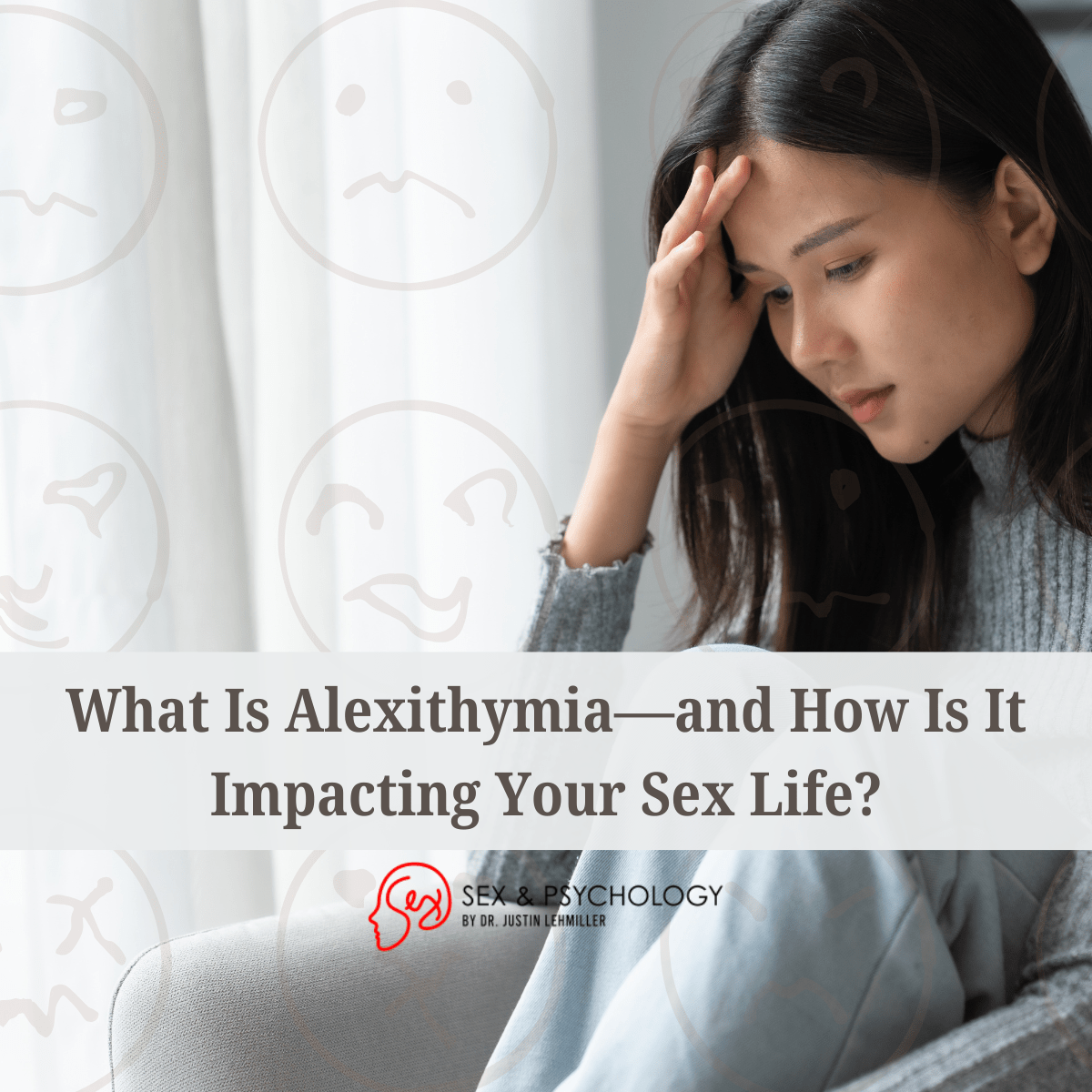
What Is Alexithymia, And How Is It Impacting Your Sex Life?
April 22, 2026 by Merissa Prine-Munroe
Most people will struggle occasionally when it comes to identifying their feelings or communicating them effectively to others. That’s a normal experience. However, some people have a chronic, disrupted sense of their emotional awareness. A growing body of research is shining a light on a psychological trait called alexithymia, with a new study published in the Canadian Journal of Human Sexuality suggesting that it may be shaping people’s sex lives in important ways.
What is alexithymia?
Alexithymia is a psychological trait characterized by difficulty identifying, describing, and processing emotions. In other words, people with alexithymia have disrupted emotional awareness and may struggle to label or communicate their feelings clearly, despite feeling them internally. It’s not considered a mental disorder; it’s just a different way of processing emotions that makes it harder to connect how you’re feeling to what’s happening in your life. It also runs on a spectrum. For some, it only shows up in certain circumstances, whereas for others, it may be pervasive. Around 10% of the population is estimated to experience some form of alexithymia.
Previous research has broken alexithymia into three core elements: 1) difficulty identifying feelings, 2) difficulty describing feelings, and 3) externally oriented thinking (i.e., attributing feelings to external rather than internal sources; Bagby et al., 1994). Individuals with an externally oriented thinking style are more likely to attribute their experiences to external factors rather than internal emotional states. For example, someone might feel that sex was unenjoyable because the room was too cold, rather than recognizing how feelings like anxiety or discomfort may have influenced the experience.
Why emotions matter in sex
Sex isn’t just a physical act–it’s often deeply emotional and intimate. Sexual desire, arousal, pleasure, and overall satisfaction are closely tied to how well we recognize and regulate our internal thoughts and feelings. Being able to acknowledge and communicate about both the physical sensations and the emotions that accompany sexual response is essential for experiencing genuine pleasure and fulfilment (Jang et al., 2025). As you can imagine, it is going to be challenging to express your sexual wants and desires to a partner if understanding and communicating your internal feelings in general is difficult.
The connection between alexithymia and sexual distress
In a recent study, Jang and colleagues (2025) examined how alexithymia relates to sexual distress (i.e., negative emotions and/or feelings about one’s sex life) across two studies with adult women and men. The researchers found a clear pattern: higher levels of alexithymia were associated with greater sexual distress.
The difficulty identifying feelings component of alexithymia was an especially important predictor of sexual distress for both men and women. This may be because being able to identify what you’re feeling in the first place is important for navigating sexual experiences in a satisfying way.
The takeaway
If sex feels confusing, disconnected, or frustrating, the issue might not be desire or compatibility; it might be a lack of emotional clarity. Sexual difficulties are often framed as purely physical or relational problems, but this research suggests that the ability to understand and identify your own emotions plays a key role in experiencing satisfying sex.
If you think that you or your partner might have alexithymia, the authors highlight that emotional awareness is a skill that can be developed. Individuals can learn to identify their experiences through emotional awareness training programs or through mindfulness interventions that aim to improve the ability to identify feelings, which may help reduce sexual distress over time.
To learn more about mindfulness techniques that can improve your sex life, check out our podcast episode with Dr. Lori Brotto, author of the book Better Sex Through Mindfulness.
If you have a sex question of your own, record a voicemail at speakpipe.com/sexandpsychology to have it answered on the blog or the podcast.
Want to learn more about Sex and Psychology? Click here for more from the blog or here to listen to the podcast. Follow Sex and Psychology on Facebook, Twitter (@JustinLehmiller), Bluesky, or Reddit to receive updates. You can also follow Dr. Lehmiller on YouTube and Instagram.
Image made in Canva.
References:
Bagby, R. M., Taylor, G. J., & Parker, J. D. A. (1994). The twenty-item Toronto Alexithymia scale—II. Convergent, discriminant, and concurrent validity. Journal of Psychosomatic Research, 38(1), 33–40. https://doi.org/10.1016/0022-3999(94)90006-X
Jang, G. E., Goldberg, S. Y., & Dawson, S. J. (2025). Alexithymia is associated with greater sexual distress among women and men. The Canadian Journal of Human Sexuality, 34(3), 533–539. https://doi.org/10.3138/cjhs-2024-0074

Dr. Justin Lehmiller
Founder & Owner of Sex and PsychologyDr. Justin Lehmiller is a social psychologist and Research Fellow at The Kinsey Institute. He runs the Sex and Psychology blog and podcast and is author of the popular book Tell Me What You Want. Dr. Lehmiller is an award-winning educator, and a prolific researcher who has published more than 50 academic works.
Read full bio >