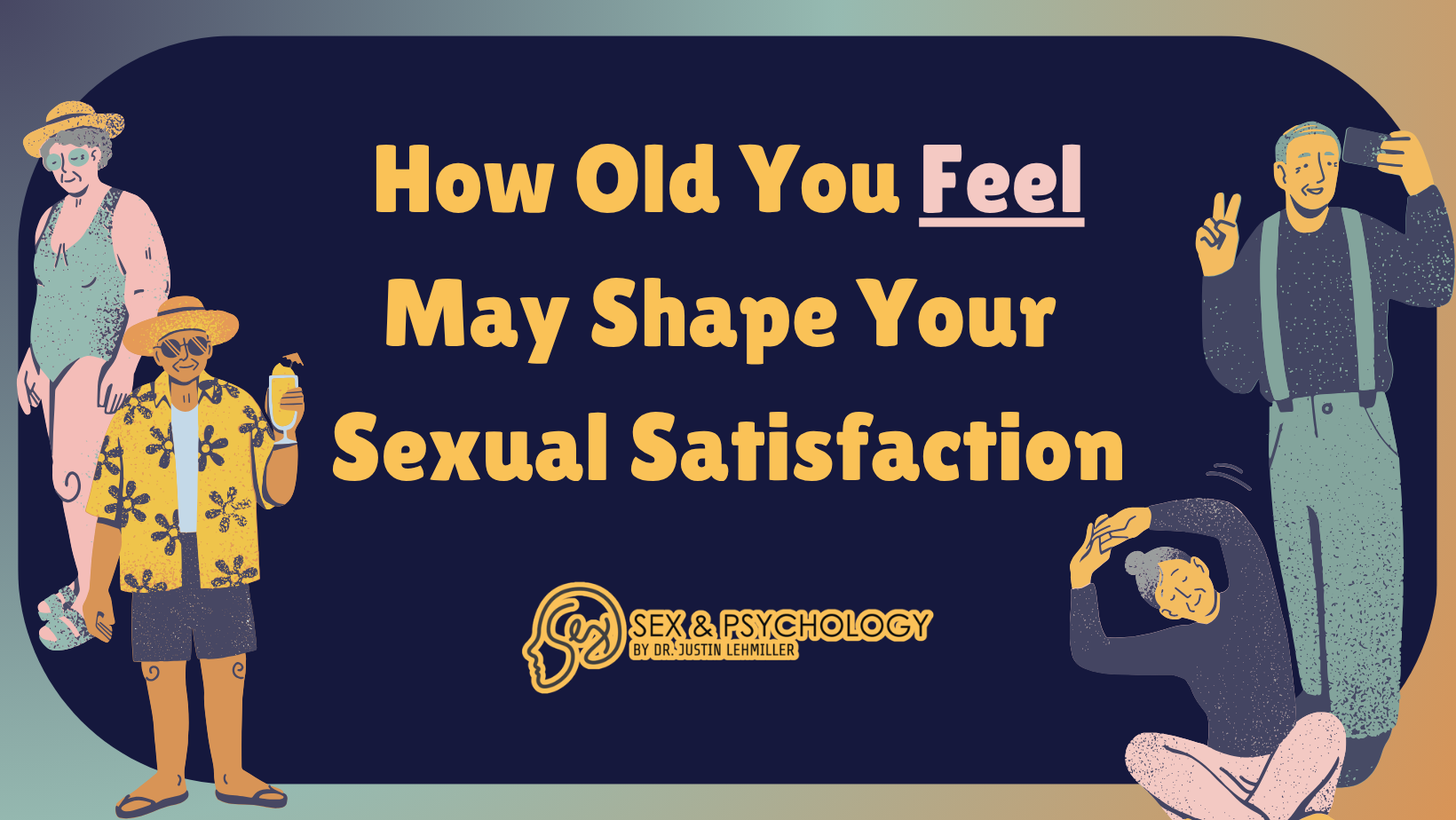
How Old You Feel May Shape Your Sexual Satisfaction
September 30, 2026 by Justin Lehmiller
How do our sex lives change as we age? Several studies have explored this question, but most have addressed it through a fairly narrow lens, focusing largely on how physical changes associated with aging affect sexual experiences.
The basic storyline to emerge from these studies is that, as we get older, our odds of developing chronic health conditions increase, and this, in turn, can negatively impact sexual frequency and satisfaction.
While certainly important, biological changes alone don’t tell the full story. Independent of our health status, psychological factors such as how old one actually feels also seem to play a big role in how older adults feel both in and out of the bedroom.
Subjective Age and Sexual Satisfaction
Consider a study published in the Journal of Sex Research that looked at data from a longitudinal survey of 1,170 American adults ages 40 and older [1]. Participants completed two surveys about 10 years apart in which they were asked several questions about their sex lives, including how much desire they have for sex, how often they do it, and the quality of their sexual experiences. They were also asked to report their subjective age, meaning the age they feel most of the time.
Results indicated that sexual frequency, quality, and interest all declined over that 10-year period. Also, consistent with previous research, those who remained in better health tended to maintain more active and satisfying sex lives.
So how did subjective age factor into all of this? Although it was unrelated to how often people had sex, feeling older than one’s actual age predicted less interest in sex over time, as well as lower levels of sexual satisfaction. Conversely, those who felt younger than they actually were had more sexual desire and were happier with their sex lives.
It’s important to note that this finding emerged in statistical models where chronological age and the presence of chronic health conditions were also included. In other words, over and above the biological effects of aging, there’s an independent effect of subjective age.
Feeling Younger Than Your Age Is Linked to Greater Life Satisfaction
People who feel younger than their actual age aren’t just happier in the bedroom. In fact, they live more satisfying lives in general. A separate longitudinal study out of England, based on a survey of more than 7,000 adults ages 50 and older, found that those who had a younger subjective age were the most content with their overall lives [2].
Specifically, those who felt like they were 25 to 30 years younger than they actually were reported the highest levels of life satisfaction. For example, people in their 90s who felt like they were still in their 60s were happier with their lives than people who felt closer to (or older than) their actual age.
Takeaways
These results are important because they tell us that if we want to understand sexual well-being among older adults, we need to look at more than just biology. We also need to consider psychological factors such as subjective age.
Independent of overall health status, people who feel older than they are seem to experience the sharpest declines in the quality of their sex lives. At the same time, the younger people feel, the more likely they are to maintain high satisfaction as they age, both in and out of the bedroom.
Broadly speaking, these findings remind us that aging is not just a biological process; it’s also a psychological one. The age you feel may influence your sexual well-being and how you move through the world in ways that your chronological age alone can’t explain. In short, our mindset around aging may be one of the most important factors in maintaining a satisfying sex life over time.
If you have a sex question of your own, record a voicemail at speakpipe.com/sexandpsychology to have it answered on the blog or the podcast.
Want to learn more about Sex and Psychology? Click here for more from the blog or here to listen to the podcast. Follow Sex and Psychology on Facebook, Twitter (@JustinLehmiller), Bluesky, or Reddit to receive updates. You can also follow Dr. Lehmiller on YouTube and Instagram.
Image made in Canva.
References
[1] Estill, A., Mock, S. E., Schryer, E., & Eibach, R. P. (2018). The effects of subjective age and aging attitudes on mid-to late-life sexuality. The Journal of Sex Research, 55(2), 146-151.
[2] Blöchl, M., Nestler, S., & Weiss, D. (2021). A limit of the subjective age bias: Feeling younger to a certain degree, but no more, is beneficial for life satisfaction. Psychology and Aging, 36(3), 360.

Dr. Justin Lehmiller
Founder & Owner of Sex and PsychologyDr. Justin Lehmiller is a social psychologist and Research Fellow at The Kinsey Institute. He runs the Sex and Psychology blog and podcast and is author of the popular book Tell Me What You Want. Dr. Lehmiller is an award-winning educator, and a prolific researcher who has published more than 50 academic works.
Read full bio >