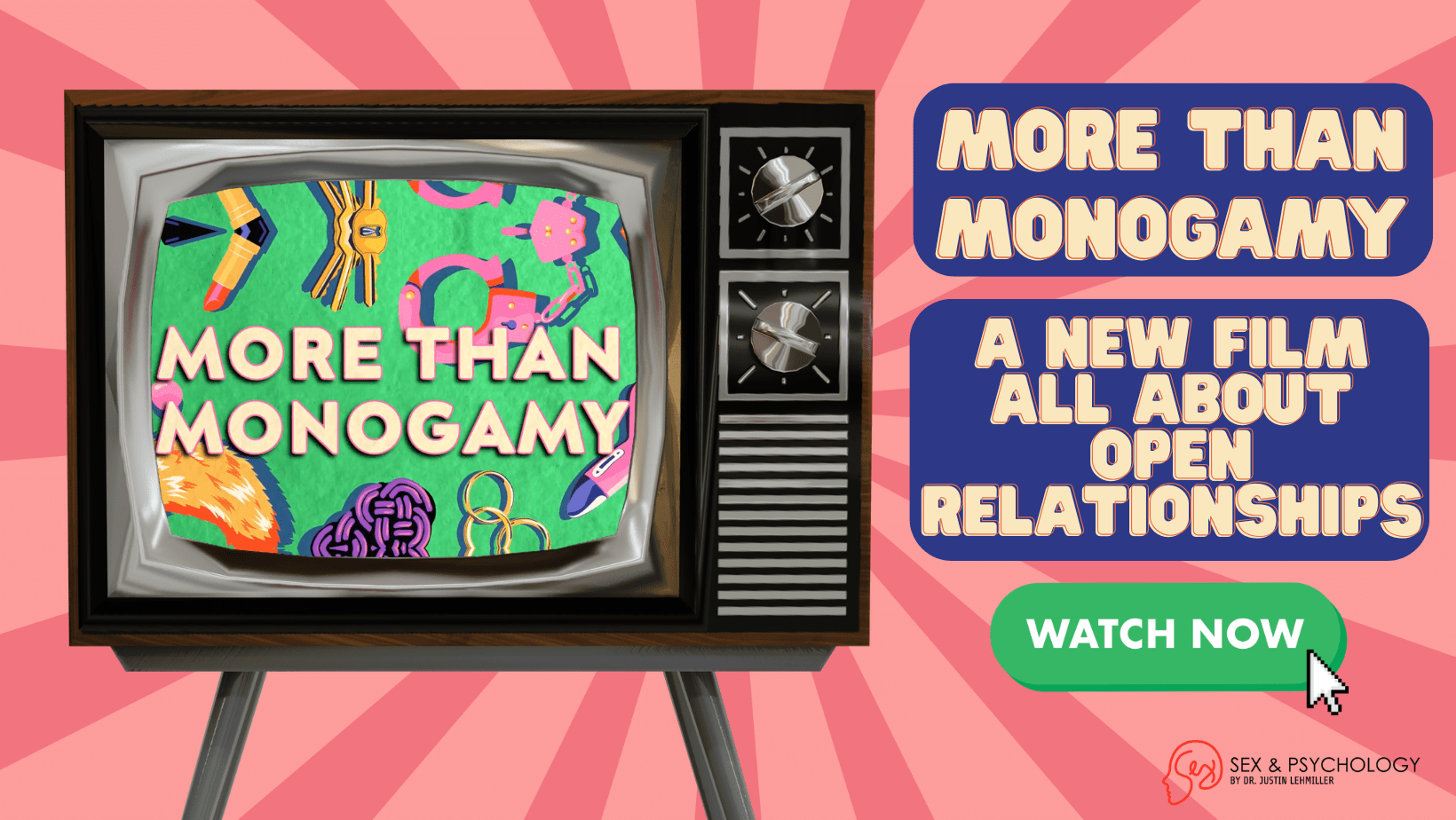
More Than Monogamy: A New Film All About Open Relationships
March 4, 2026 by Emily Mendelson
When it comes to relationships, monogamy is usually the default. The person with whom you have sex is the person you are also romantically committed to. However, monogamy doesn’t work well for everyone. For example, some people find that it’s restrictive to their personal growth and/or their ability to fully explore their sexuality. It is reasons such as these that lead many to open their relationships in some way.
But being in a consensually non-monogamous relationship can be intimidating and challenging to people who have previously only ever known and experienced monogamy. This is where a new film, More Than Monogamy, comes in.
More Than Monogamy is a feature-length documentary that explores everything you need to know when it comes to non-monogamous relationships. This includes discussion of different types of consensual non-monogamy, common myths and misconceptions about it, as well as practical information on how to make sexually open relationships work.
After watching it for myself, I interviewed Dillon Birdsall, one of the filmmakers. He was able to shed some light on the story behind the film, as well as where viewers can learn more about non-monogamous relationships.
Producing More Than Monogamy
First, I wanted to know a little bit more of the “behind the scenes” of making the film. I asked Dillon about his team’s overall motivation for producing the documentary. Here’s what he told me:
So my first feature-length documentary, called V-Card The Film, was all about my virginity. I spent years talking to people about what it meant to be a virgin in modern times. Through making that film and doing research on it, I got a lot of information about alternative lifestyles and, in fact lost my virginity to someone who was poly. So I thought it might make for a good second film. I approached my partners at Spark Erotic, whom I met at another sexuality film festival and who have an amazing backlog of films dealing with these subjects as well, and my co-director, Urvashi, because I knew that they had tons of experience in these areas as well, and figured it would make for a great mixing of ideas and influences. I wanted to make sure we had a well-rounded and inclusive view when making this movie.
I really wasn’t super happy with other documentaries I’d seen about this topic, which always seemed to focus on how weird or taboo this stuff was, and it just didn’t seem like that to me. I knew plenty of people in the lifestyle at this point who were just living very normal lives that happened to be more open to different sexuality. I thought it would be awesome if there was a documentary that people could use to better understand the lifestyle with less judgment and more education, and I think we nailed the execution of that with this film.
While watching the film, you’ll hear from several sex therapists, educators, authors, and academics (including Dr. Justin Lehmiller). Dillion told me that getting this variety of perspectives interspersed in the film was important to “show that the lifestyle can be for anyone of any background.” The people who were featured “have been doing great work in the sexuality and mental health space for years,” and the More Than Monogamy team feels “that these incredible individuals allowed us their time and knowledge; we truly couldn’t have done this film without them.”
Content in More Than Monogamy
Second, I wanted to know a little bit more about some of the specific content in the film itself. Although there is a lot of explanation about various relationship arrangements, I was struck by how the film also discusses the origin of non-monogamy in American culture. I asked Dillon what viewers might be surprised to know about this history of open relationships. He said:
I think, like most things, once you start peeling back layers of the onion, you realize that there is so much more to the world than you realize. As we state in the film, monogamy might be the best relationship model for you, but it definitely isn’t the only one, and honestly, if you’ve ever been curious, there is so much out there for you to discover.
Viewers might be surprised to learn from our research that swinging in the U.S. seems to have started in the U.S. Military. They might also be surprised to learn that polyamory has had a super-long history all around the world, but it has a very interesting history right here in America, which we get into more detail in the film.
For those curious about participating in the lifestyle, I also asked Dillon about some of the skills that people need when it comes to open relationships. Of course, like all relationships, communication is key, but it’s not the only thing that matters. Dillon described three skills to keep in mind:
Skill 1 – Honesty: When you can be honest with yourself and the people around you, it opens up so much more of your life. It allows you to really live a life that feels right to you because you’re not lying about what you really want or need.
Skill 2 – Curiosity: I think one of my favorite aspects of the lifestyle is that people seem genuinely curious about a lot of stuff. They want to learn more about this new term, this new relationship model, this new sex toy. I think the lifestyle allows you to maybe be more open to new experiences, and you have to be curious to take those first steps
Skill 3 – Diversified Need Fulfillment: Finally, a super important aspect of the lifestyle is admitting that putting so much pressure on your partner to be this perfect person who fulfills all your wants and needs is kinda not fair to that partner, and that it’s ok to find other people in your life to fill those holes in your relationship. It’s ok to find joy in other people, it’s ok to need things that maybe your partner can’t fulfill, as long as we’re open and honest about it. Life is so much richer when we find the people we mesh with, and if that involves sex or love, cool!
Watch More Than Monogamy and Learn More
The team that produced More Than Monogamy is a small group of just 3 people, so we encourage you watch the film in order to support them directly. You can check out the More Than Monogamy website to buy the film through the homepage. Dillon told me that the team hopes to make the film available for streaming near the end of this year, but buying it directly from them is currently the only way to watch.
When viewing the film, you may find that there’s a lot to learn about the lifestyle and open relationships. And if it seems overwhelming, Dillon gave some great advice. He said:
Take it slow. This lifestyle isn’t going anywhere; take as much time as you need. I think anyone interested in these topics should use this film as a starting point, not a final destination. Take the stuff we talk about in this film and do more research, look into more things, and start building a framework that works for you.
The world of sexuality is so massive, so complex, so diverse that you’d be doing yourself a disservice if you didn’t take a little time to explore it for yourself, but that exploration can take as long as it needs to make you feel comfortable.
To watch the film for yourself, click here: https://morethanmonogmay.gumroad.com/l/wcgytu
If you have a sex question of your own, record a voicemail at speakpipe.com/sexandpsychology to have it answered on the blog or the podcast.
Want to learn more about Sex and Psychology? Click here for more from the blog or here to listen to the podcast. Follow Sex and Psychology on Facebook, Twitter (@JustinLehmiller), Bluesky, or Reddit to receive updates. You can also follow Dr. Lehmiller on YouTube and Instagram.
Image made in Canva.

Dr. Justin Lehmiller
Founder & Owner of Sex and PsychologyDr. Justin Lehmiller is a social psychologist and Research Fellow at The Kinsey Institute. He runs the Sex and Psychology blog and podcast and is author of the popular book Tell Me What You Want. Dr. Lehmiller is an award-winning educator, and a prolific researcher who has published more than 50 academic works.
Read full bio >