
What Do Normal Vulvas Look Like?
July 17, 2026 by Merissa Prine-Munroe
Many women worry about whether their genitals look “normal.” Concerns about the size, shape, symmetry, and/or color of the labia can leave women feeling self-conscious and, in some cases, lead them to consider cosmetic surgery such as labiaplasty, a procedure designed to reduce or reshape the labia minora.
The irony is that many women who seek labiaplasty already have perfectly healthy, typical anatomy. Research consistently shows that there is no single “normal” appearance for the vulva. Instead, vulvas vary tremendously from one person to the next. Understanding this natural diversity can help challenge unrealistic beauty standards and reduce unnecessary anxiety about genital appearance.
In a previous blog, we discussed a study in which more than 4,000 participants viewed 16 photographs of labia and rated how “normal” they thought each one looked. Unbeknownst to participants, the images represented just eight women, with each woman shown both before and after undergoing labiaplasty. [1] Researchers found that participants consistently rated the post-surgery images as more “normal” than the natural, pre-surgery images. More broadly, participants tended to evaluate vulvas negatively overall, suggesting that many people hold unrealistic expectations about female genital appearance.
The findings are striking because the labia judged to be the most “normal” had been surgically altered to conform more closely to prevailing beauty ideals. This highlights an important misconception: many people’s mental image of a “normal” vulva is actually based on a narrow aesthetic standard rather than the wide range of appearances that occur naturally.
In this article, we’re going to dig further into research on diversity in vulva appearance.
Does Race Matter?
In an effort to see whether these findings would hold up in a more diverse sample, participants were shown images six women’s vulvas, both before and after labiaplasty. [2] Half of the vulvas belonged to White women; half belonged to Black women. Participants were asked about their perceptions of them. Just like in the original study, people generally rated the post-operative images as more “normal.”
However, there were some interesting differences between how White and Black labia were perceived. Of the images before labiaplasty, Black labia were evaluated as more normal than White labia. However, White labia were perceived as more normal than Black labia in the post-surgery images. The authors suggest that this may be due to greater acceptance of labial diversity in Black women, while perpetuating norms for a “tucked in look” for White women. It’s not entirely clear why unaltered Black labia were more accepted, which points to a need for further research to see how factors like race influence perceptions of women’s bodies.
What Do “Normal “Female Genitals Look Like?
There is very little research about what “normal” labia look like. In one study, gynaecologists collected measurements of the genitals of over 600 White women aged 15 to 82 [3]. The average labia minora was about 1.6 to 1.7 inches long and about 0.5 inches wide, while the labia majora (outer lips) were approximately 3.1 inches long. However, the authors cautioned against assuming there is one “normal” way for women’s genitals to look, instead suggesting that differences must be interpreted on an individual basis.
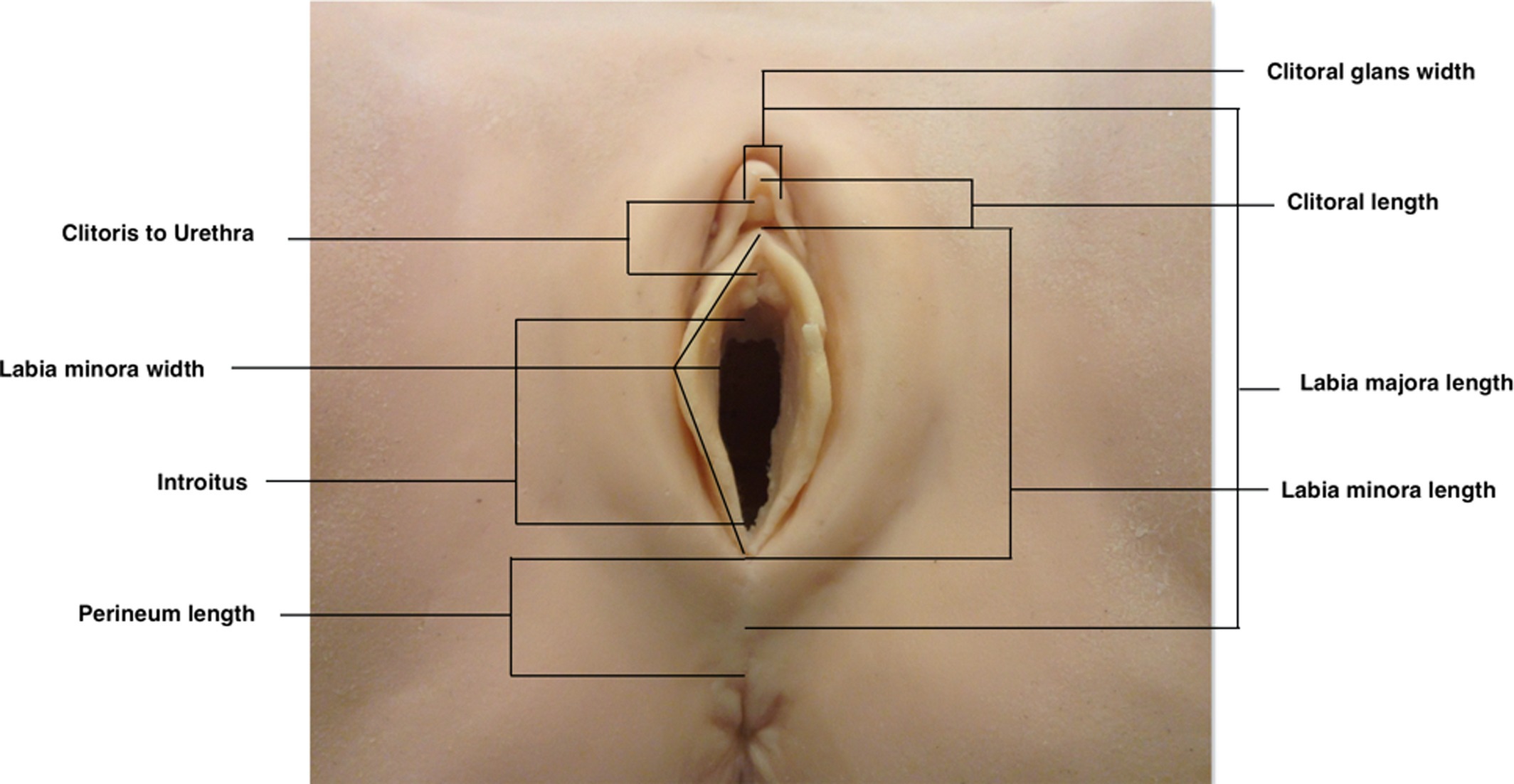
Image from Kreklau et al. (2018)
In a separate study of 44 adolescent women, researchers measured characteristics of the labia and documented a lot of natural variation [4]. The lengths of the left and right labia often differed, as did labial width, demonstrating a wide range of sizes, shapes, and anatomical differences among the labia minora. Additionally, 75% of participants had variation in colour either between the labia minora or between the base and tip of the labia, as well as differences in texture. The authors concluded that there was “great variability in the size, symmetry, and morphology” of the vulva (p. 29).
Am I Normal?
Returning to the question, “Am I normal?,” the answer is that if your vulva is not causing pain, discomfort, or other health problems, it is most likely a healthy and completely normal variation of human anatomy. Remember: there is no single “correct” way for a vulva to look.
Fortunately, efforts to improve education and awareness about the diversity of vulvar anatomy are growing. Resources such as The Labia Library, which features a collection of non-sexualized images showcasing the natural variation in labia, help challenge narrow beauty standards and remind women that there is tremendous diversity in what healthy vulvas look like. By exposing people to this natural variation, these resources can foster greater body acceptance and reduce unnecessary concerns about whether one’s vulva is “normal.”
If you have a sex question of your own, record a voicemail at speakpipe.com/sexandpsychology to have it answered on the blog or the podcast.
Want to learn more about Sex and Psychology? Click here for more from the blog or here to listen to the podcast. Follow Sex and Psychology on Facebook, Twitter (@JustinLehmiller), Bluesky, or Reddit to receive updates. You can also follow Dr. Lehmiller on YouTube and Instagram.
References
[1] Skoda, K., Oswald, F. E., Shorter, L., & Pedersen, C. L. (2021). Perceptions of Female Genitalia Following Labiaplasty. The Journal of Sex Research, 58(7), 943–950. https://doi.org/10.1080/00224499.2020.1808563
[2] Oswald, F., Walton, K. A., Khera, D., Champion, A., & Pedersen, C. L. (2022). Evaluations of Black and White female genitalia by labiaplasty status: A pre-registered contextualization, replication, and extension of findings on labial perceptions. The Journal of Sex Research, 59(9), 1163–1174. https://doi.org/10.1080/00224499.2022.2050667
[3] Kreklau, A., Vâz, I., Oehme, F., Strub, F., Brechbühl, R., Christmann, C., & Günthert, A. (2018). Measurements of a ‘normal vulva’ in women aged 15–84: a cross‐sectional prospective single‐centre study. BJOG : An International Journal of Obstetrics and Gynaecology, 125(13), 1656–1661. https://doi.org/10.1111/1471-0528.15387
[4] Brodie, K., Alaniz, V., Buyers, E., Caldwell, B., Grantham, E., Sheeder, J., Wilcox, D., & Huguelet, P. (2019). A study of adolescent female genitalia: What is normal? Journal of Pediatric & Adolescent Gynecology, 32(1), 27–31. https://doi.org/10.1016/j.jpag.2018.09.007
Banner image made in Canva.

Dr. Justin Lehmiller
Founder & Owner of Sex and PsychologyDr. Justin Lehmiller is a social psychologist and Research Fellow at The Kinsey Institute. He runs the Sex and Psychology blog and podcast and is author of the popular book Tell Me What You Want. Dr. Lehmiller is an award-winning educator, and a prolific researcher who has published more than 50 academic works.
Read full bio >