What is Amatonormativity and Why Does it Matter?
June 18, 2026 by Merissa Prine-Munroe
Pride Month often emphasizes celebration, allyship, and the message that “love is love.” But what counts as love? Which relationships are valued and respected? Do relationships have to be romantic to be considered valid? Do they need to include sex? These questions point to a broader social assumption known as amatonormativity. In this week’s blog, we’ll explore amatonormativity and discuss findings from a recent study published in the Journal of Sex Research by Mollet and colleagues (2026), which examined how asexual and aromantic people experience intimacy and build meaningful relationships.
What is Amatonormativity?
Amatonormativity is the assumption that everyone is seeking (or should be seeking) a long-term, exclusive, romantic relationship. It emphasizes romantic love and marriage as the “best” type of relationship, while also de-emphasizing the importance other types of intimate relationships (e.g., friendships, familial relationships, friends with benefits). By encouraging the belief that pursuit of romantic relationships is the norm and should be everyone’s priority, amatonormativity can impact how people think about and value other relationships they have in their lives, such as by not seeing platonic relationships as equally valuable and fulfilling.
Asexual and Aromantic Identities
If you haven’t heard these terms before, asexuality generally refers to experiencing little to no sexual attraction towards others, while aromanticism refers to experiencing little to no romantic attraction to others. Importantly, both identities exist on a spectrum, meaning that people’s experiences can vary widely. These identities are sometimes referred to as a-spec for people who are on the asexual spectrum, the aromantic spectrum, or both. To learn more, check out our podcast episodes that explain asexuality in more detail (Episode 189 and Episode 65), or check out our blog post that highlights adopting an a-spec lens.
Because amatonormativity is deeply embedded in our culture, romance and sexual passion are often treated as the primary markers of relational success. As a result, asexual and aromantic individuals frequently face stigma, discrimination, or assumptions that they are missing qualities considered fundamental to being human (Mollet et al., 2026). Many people are unfamiliar with these identities and may make narrow assumptions about the relational lives of a-spec individuals. These misconceptions can leave a-spec people feeling misunderstood and isolated, particularly when Pride messaging continues to emphasize romantic love and sexual attraction as central components of valid and meaningful relationships.
Celebrating Asexual and Aromantic Identities
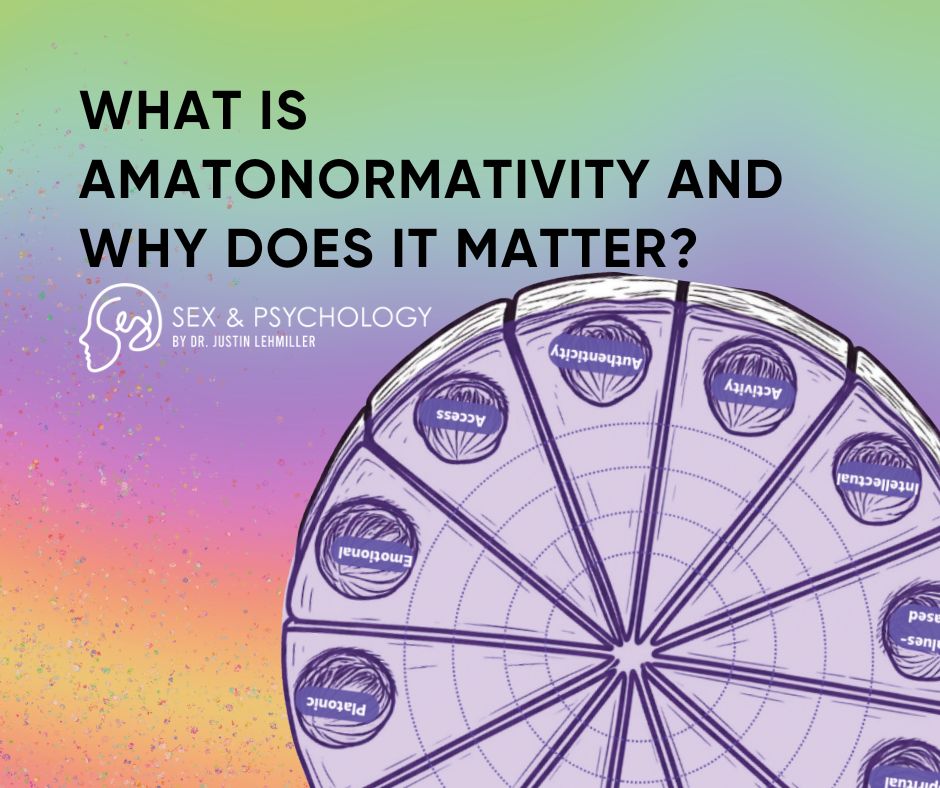
Mollet and colleagues (2026) conducted a qualitative study of the intimacy experiences of a-spec individuals, challenging amatonormativity and highlighting the diverse ways in which a-spec people create and maintain their close relationships. Through interviews with a-spec college students in the United States and a qualitative survey on Prolific, the authors were able to identify numerous types of intimacy that a-spec people thought were important in their relationships. The authors illustrated these various types of intimacy in the “expansive intimacies cake” pictured below to show that there are many different components to intimacy, beyond just romance and sexual intimacy.

The authors highlighted that a-spec people spoke about their relationships in expansive ways rather than focusing on the “absence” or “lack of” romantic or sexual attraction. Instead, they spoke about far more types of intimacy that were important to their relationships. For example, many mentioned about being able to share their thoughts and feelings (emotional intimacy), or being in relationships that emphasized mutual well-being and respect (platonic intimacy).
Both sexual intimacy and romantic intimacy were not considered essential by most participants in the study. Instead, sexual intimacy was often understood as overlapping with other forms of intimacy (like emotional or erotic intimacy) and was described less as something driven by sexual attraction toward a partner and more as a way of fostering connection. Romantic intimacy was particularly difficult for participants to define, with many expressing uncertainty about what it specifically entails. Definitions varied widely and often drew on other forms of intimacy, suggesting that romantic intimacy is not a clearly bounded or easily articulated concept for many individuals. In other words, while these qualities are meaningful in relationships, they are not necessarily the only (or most important) features of fulfilling relationships.
To be clear, this doesn’t mean that asexual and aromantic individuals never experience sexual desire or romance, or that these qualities are completely unimportant to them. Instead, it seems that these qualities are less emphasized by a-spec people and may or may not be considered valuable in their close relationships. It is also important to note that there is a lot of diversity within this group. Some people may think that sexual intimacy is a vital component of their relationships, whereas others may not see it as important at all.
This research challenges the assumption that meaningful relationships must always be romantic or sexual. It highlights that intimacy is multifaceted and can be expressed in many different ways. By examining the experiences of asexual and aromantic people, the study encourages us to question amatonormative beliefs that place romance and sex at the center of human relationships. Rather than treating these forms of intimacy as the gold standard, we can recognize that different people build fulfilling relationships in different ways. As the authors suggest, the intimacy “cake” can serve as a useful tool for discussing needs and expectations without assuming that intimacy means the same thing to everyone. In doing so, we can create more inclusive understandings of connection and what it means to have a meaningful relationship.
If you have a sex question of your own, record a voicemail at speakpipe.com/sexandpsychology to have it answered on the blog or the podcast.
Want to learn more about Sex and Psychology? Click here for more from the blog or here to listen to the podcast. Follow Sex and Psychology on Facebook, Twitter (@JustinLehmiller), Bluesky, or Reddit to receive updates. You can also follow Dr. Lehmiller on YouTube and Instagram.
References:
Mollet, A. L., Valley, S. N., & Fitzsimmons, B. (2026). Expansive intimacies: Celebrating the intimacy of asexual and aromantic people. The Journal of Sex Research, 1–15. https://doi.org/10.1080/00224499.2026.2658111
Banner made in Canva; image from Mollet et al., 2026

Dr. Justin Lehmiller
Founder & Owner of Sex and PsychologyDr. Justin Lehmiller is a social psychologist and Research Fellow at The Kinsey Institute. He runs the Sex and Psychology blog and podcast and is author of the popular book Tell Me What You Want. Dr. Lehmiller is an award-winning educator, and a prolific researcher who has published more than 50 academic works.
Read full bio >