
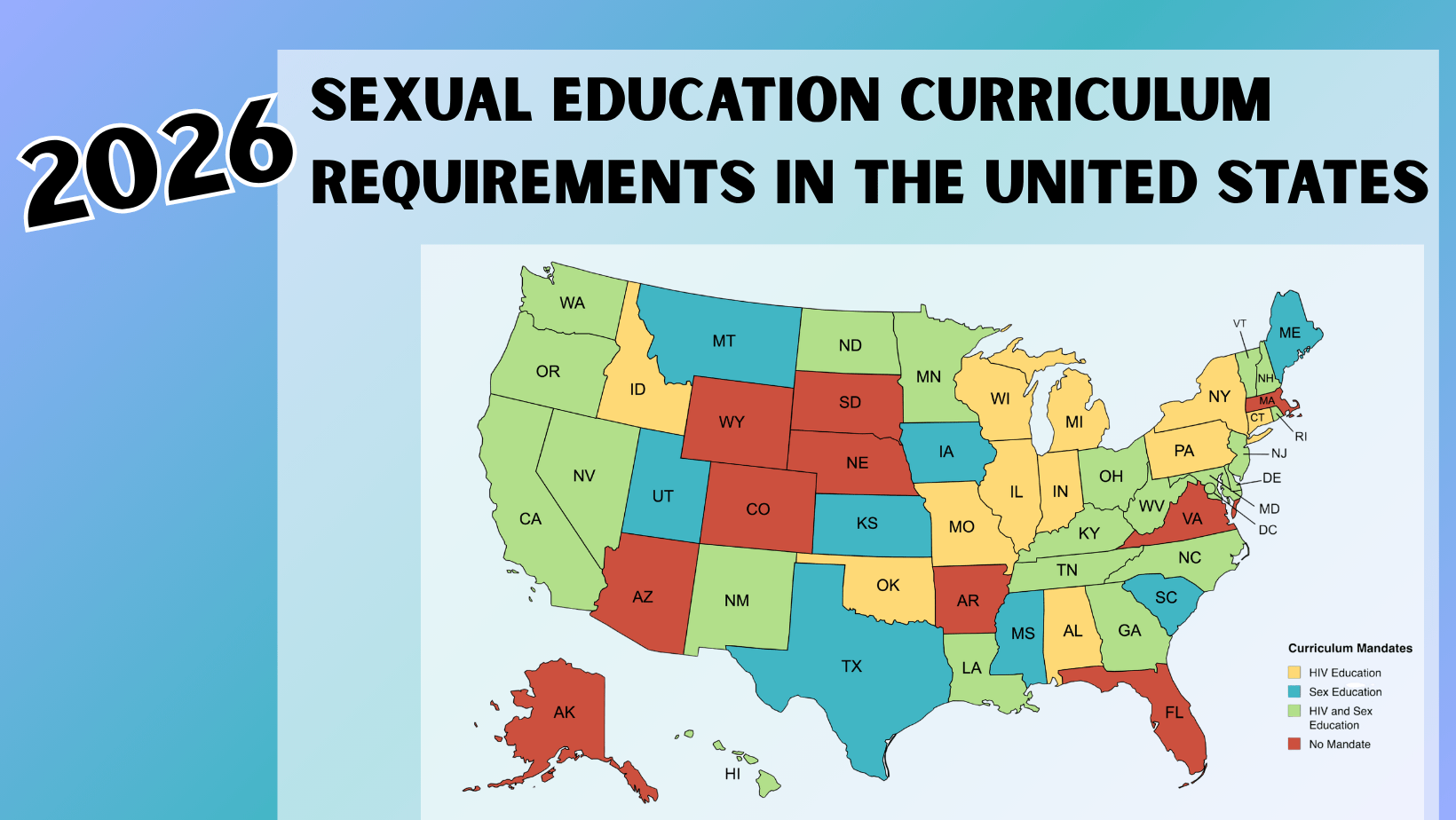
2026 Sexual Education Curriculum Requirements In The US
April 1, 2026 by Emily Mendelson
The Guttmacher Institute does a great job of tracking state laws and policies related to sexual and reproductive health as they evolve and change. Today, we’re going to look into their most recent data on sex and HIV education across the United States.
The last time we reviewed this data was in January 2025, so we’ll also discuss how things have changed from a year ago. In addition, for those who had less than stellar sexual education or are looking for help having “the talk” with their kids, we’ll provide some evidence-based sources to fill in the gaps.
2026 Curriculum Mandates
The image below gives an overview of how sex and HIV education curriculum mandates vary state-to-state. States shaded in yellow mandate HIV education, states shaded in blue mandate some form of sex education, and states shaded in green mandate both HIV and sex education. States shaded in red do not have a mandate for either form of education.
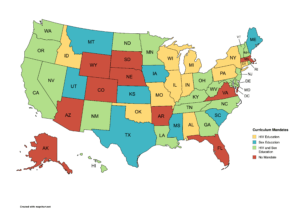
It’s important to note that a state-mandated curriculum requirement does not mean that the education provided on that topic necessarily has to be accurate, fair, or even helpful to students. In fact, some requirements are actively harmful. For example, Alabama and Oklahoma both mandate HIV education in schools, but they also mandate “instruction that portrays sexualities other than heterosexuality and gender identities other than cisgender as shameful, unacceptable, or illegal.” Requirements such as this make it clear that some of these mandates aren’t really about advancing sexual health and education as much as they’re about advancing political agendas.
Changes from 2025 to 2026
The table below compares the number of states that adhere to different requirements for sex and HIV education from 2025 to 2026. The biggest change from last year is that five more states now require sexual consent to be covered in sex ed curriculum, and two more states have added sex and HIV education mandates. However, two more states now require that students receive negative or no information about LGBTQ+ identities.
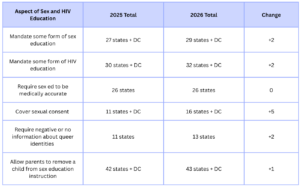
Although these changes may be subtle, they demonstrate how the landscape of sex and HIV education continues to change. For example, one positive development is that more states now require students to learn about sexual consent; however, a majority still do not. What could be more fundamental than consent?
In addition, a growing number of states have proposed or added curriculum mandates that make it harder to provide an accurate picture about sex and HIV. For example, a bill under consideration in Idaho would prevent public schools from teaching about sexual orientation or gender identity through grade 12. As we predicted last year, misinformation about LGBTQ+ people seems to be increasing in schools.
It’s also worth noting that of the more than 650 state-level bills targeting sex education last year, a quarter of them were aimed at limiting access or reducing the scope of what could be taught. While sex education is advancing in some parts of the country, it is regressing in others.
Sources of Science-Based Sexual Education
For those looking for sex ed resources, we have a few recommendations on places to start.
For parents looking to talk to their teens, check out these books:
- Yes, Your Kid: What Parents Need to Know About Today’s Teens and Sex by Debby Herbenick
- The Pride Guide: A Guide to Sexual and Social Health for LGBTQ Youth by Jo Langford
- Consent: The New Rules of Sex Education: Every Teen’s Guide to Healthy Sexual Relationships by Jennifer Lang
- Read Me: A Parental Primer for “The Talk” by Lanae St. John
For further information, we encourage you to check out the Sex and Psychology Podcast to learn more about your sex-related questions and concerns. With almost 500 episodes to dates, you’ll find plenty of content on almost any topic you might want to learn more about.
If you still can’t seem to find what you’re looking for, record a voicemail with your question at speakpipe.com/sexandpsychology to have it answered on the blog or the podcast.
Want to learn more about Sex and Psychology? Click here for more from the blog or here to listen to the podcast. Follow Sex and Psychology on Facebook, Twitter (@JustinLehmiller), Bluesky, or Reddit to receive updates. You can also follow Dr. Lehmiller on YouTube and Instagram.
Images made in Canva and MapChart. Data from Guttmacher Institute as of September 16, 2025.

Dr. Justin Lehmiller
Founder & Owner of Sex and PsychologyDr. Justin Lehmiller is a social psychologist and Research Fellow at The Kinsey Institute. He runs the Sex and Psychology blog and podcast and is author of the popular book Tell Me What You Want. Dr. Lehmiller is an award-winning educator, and a prolific researcher who has published more than 50 academic works.
Read full bio >